
Reading for Pleasure vs. Reading for Education
Or why Jane Austen sucks

Two in one day, aren’t you all spoiled for content? So, the required disclaimer: this is an opinion and I am an asshole. If you don’t like my opinion you’re welcome to ignore it, but having said that I’m still going to give my opinion and you don’t have to like it. And what is this opinion? What have I said that so deeply offended the literarti?
I hate Jane Austen.
Now lets be fair and equitable, the woman is an excellent writer. You don’t get published and you don’t get reprinted for decades, and people don’t still read you if you’re not capable. What’s more, my mom - patron saint of many a conversation here at the Thing - loved Bridget Jones’ Diary and Pride and Predjudice and Zombies. All of this wouldn’t exist without Jane Austen so lets give her the deserved laurels.
That doesn’t mean what she wrote isn’t utter dross.
In the same high school literature course where I had to read Of Mice and Men - which I loved - and All Quiet on the Western Front, a pair of droning wartime parables one about Scandinavia in WWII and one about two Afro-American soldiers in Korea, and was busily not doing that to instead read The Books of Blood by Clive Barker, The Running Man by King under the pen name Richard Bachman, and both City and The Werewolf Principle by Richard Simak, I was compelled to read Pride and Predjudice.
Now, this is a bad starting place to begin with. Being forced to read books by educational mandate is a terrible way to expose people to art. I’ve read Maya Angelou and Lee Harper’s To Kill a Mockingbird, but being forced to read them in school didn’t give me an appreciation for their literary content. However, this is compounded by the content of Austen’s work.
Enter Mr. Bennet, a hapless boob with a demanding wife and several beautiful yet utterly vapid daughters. Of middling means, like many of the upper middle class not advanced enough to truly be gentry but not low enough to toil in early Victorian England, he and his wife must conspire to marry off these daughters well or neither they nor their parents will be taken care of. It does not help that both Mr. and Mrs. Bennet have made some poor financial decisions and frittered away their funds on inheritances that only happen if there is a male inheritor; so there is a growing necessity to get this done as soon as possible.
What follows is indeed a classic for those who enjoy downstairs/upstairs soap operas like Downton Abbey in the form of a series of incidences and vignettes designed to bring brusque no nonsense Mr. Darcy together with Elizabeth Bennet, middle daughter of the family who has some positive traits - in that she is also no bullshit - but is also possessed of many behaviors we would today call a girl boss. She’s just so smart and strong willed you see, not at all like her doe eyed sisters, and so she can change Mr. Darcy who becomes enamored of her. All of this swirls around the scheme to ensnare wealthy man about town Mr. Bingley, who is also rich and of consequence who subsequently falls in love with the most beautiful eldest Bennet daughter Jane; in a book by a woman named Jane.
Now to clarify, before anyone can jump in and go “you just hate women you misogynist!”, consider that before I ever read Jane Austen I had read one of her contemporaries: Mary Shelly. I own several copies of Frankenstein and just as many pastiche, and prefer it to Dracula. Shelly was also of a mind and a sort who didn’t go in for quiet pastel desperation. She was a lady in the English sense, but she also very much wore the pants in her relationship with Percy Shelly the poet, and was much beloved by her peer group. This era that gave rise to so many well known books was the rudiments of a movement towards powerful and independent women that would see its apex in woman adventurers like Amelia Erhardt. Was there a conservative backlash? Of course. Did that stop them? Heck no. That is one of the many lies that modern politicos love to spin because they are desperate for you to believe narratives. Jane Austen and Mary Shelly both are trailblazers in fiction and laid the groundwork for others to follow.
But holy shit does that not mean that Pride and Prejudice is not the most insipid trash I’ve ever read. The girls are all exactly that: girls, fit only for marriage and pleasant conversation in the drawing room. These are the hoary ghosts of Jackie Kennedy to come. They all sit on couches and faint talking about boys while the men doubtless stand in the study and smoke over brandy while discussing business. You could posit this is intentional, that this is a scathing criticism of the time, and that through the character of Elizabeth we are shown how bullshit it all is. That doesn’t change that there’s almost an entire chapter dedicated to that time rather than wait for a carriage Elizabeth got on a horse, rode cross country, and showed up sweaty and gross to Mr. Bingley’s house so she could vamp on the men all by herself while the staff waited on her hand and foot; the menfolk being uncomfortable because she was glowing with prominent implicitly sexual energy from all that exercise.
I’ve said it before, I’ll say it again: I was forced to read it once, you can’t make me do it again on a bet with a gun to my head.
Yet, somehow, having this opinion was tantamount to being mentally retarded. How dare you not like what we like. Who are you to question the Literati who know exactly what literature is? You cad! You bounder! You scum.
Need proof?
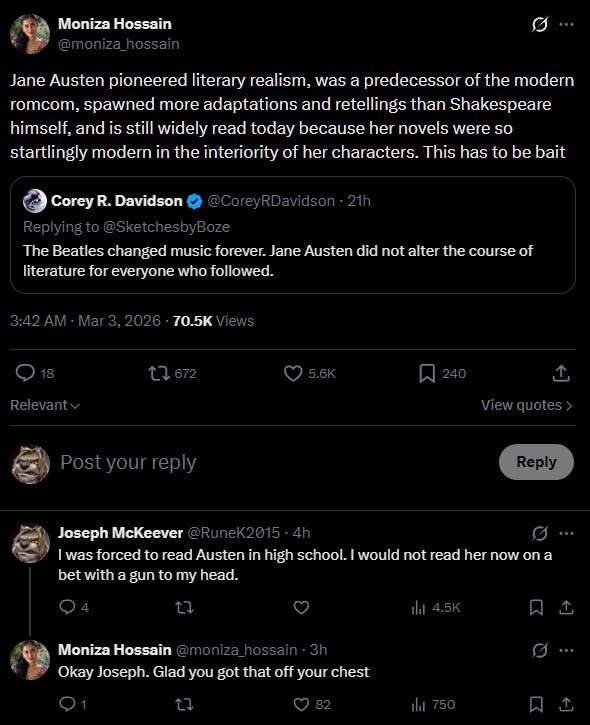
Zoom and enhance:
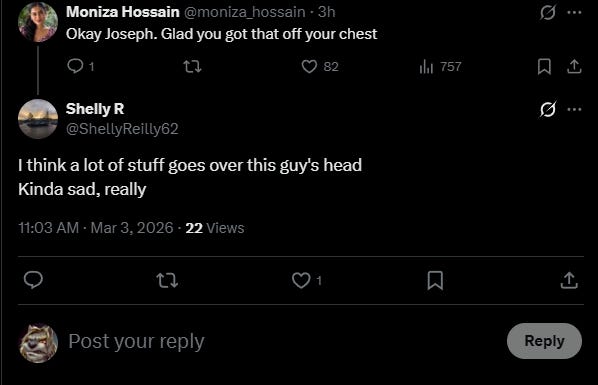
And further!
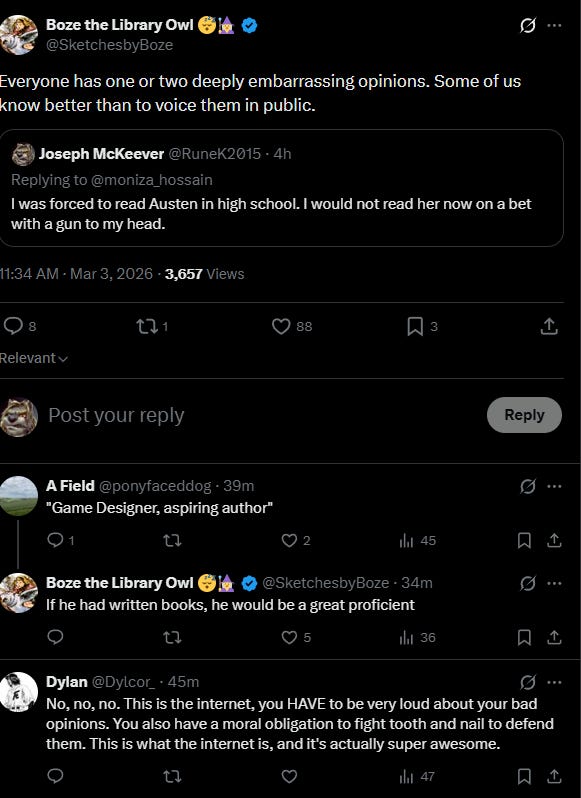
And they aren’t done yet!
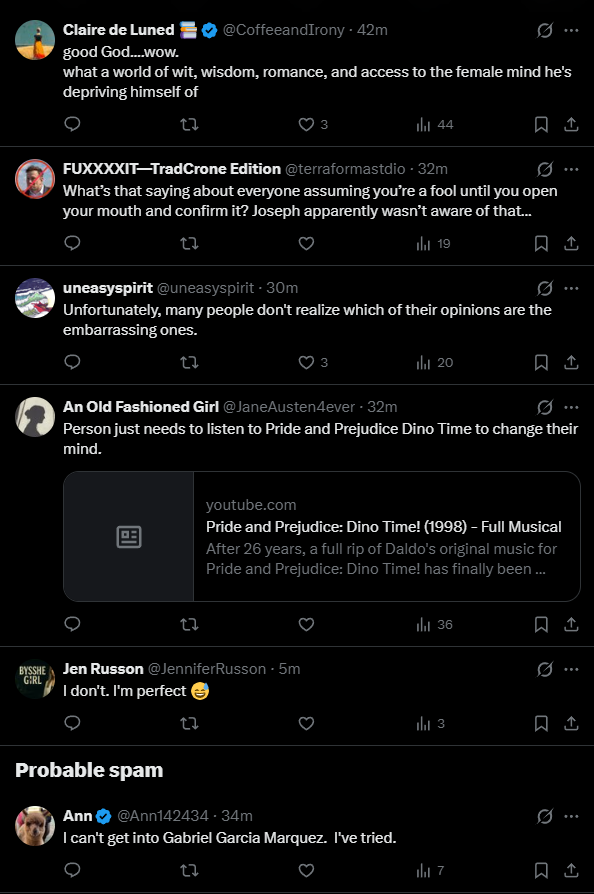
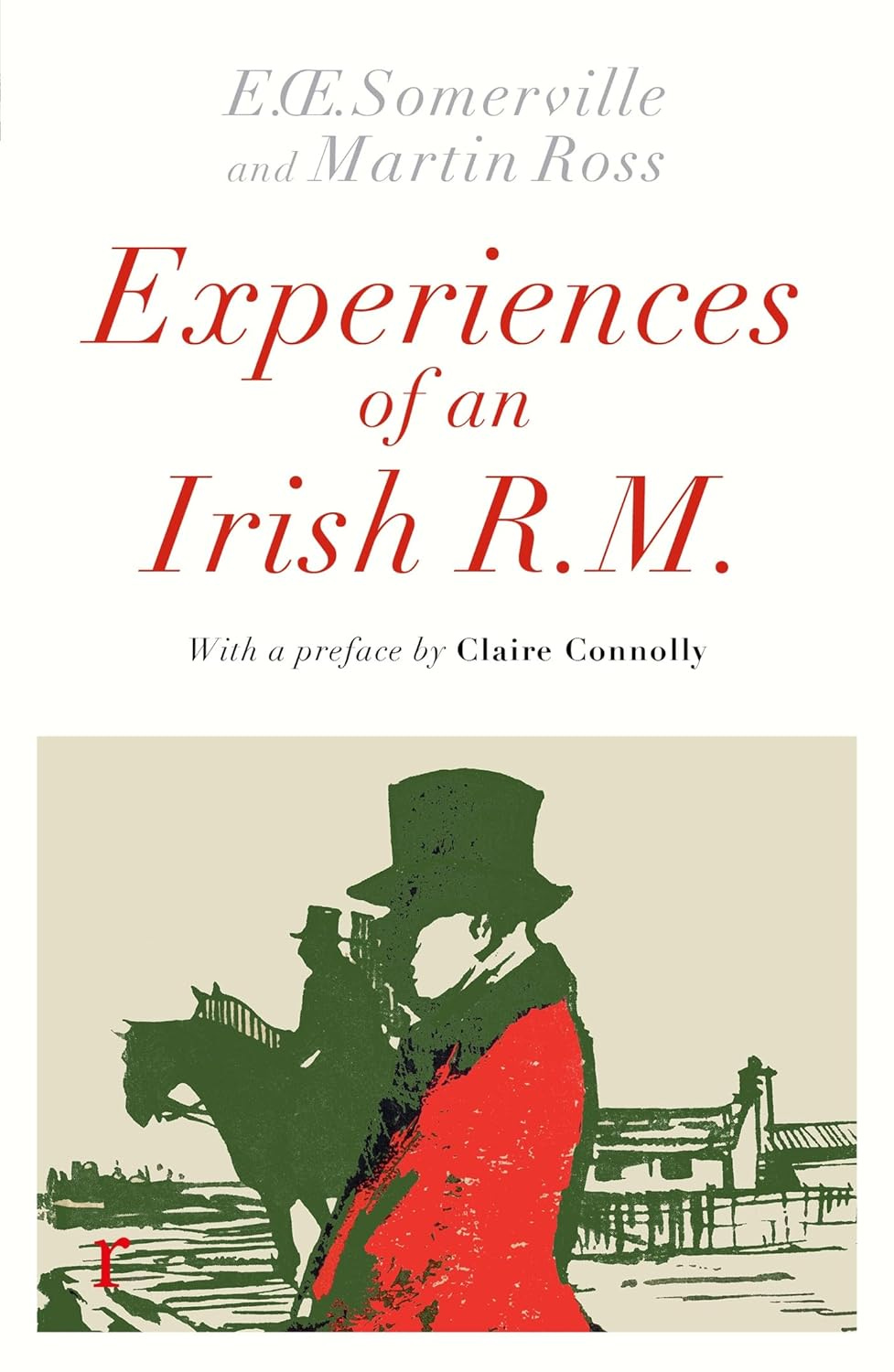
So you heard it here first, folks: I don’t know what I’m talking about. These people on the Internet know better and are here to tell you what’s what. As an aside, if you want an actual good time reading period pieces that are also contemporary of Jane Austen try Edith Somerville and Violet Florence Martin’s Some Experiences of an Irish R.M. its smart and funny despite being a bit absurdist at times, and feels far more authentic than Jane Austen’s dry drawing room characters. I read those too, have a copy somewhere in the library, and I’ve seen the Masterpiece Theater presentation of same. Poor Major Yeates perpetually getting played by Flurry Knox who is always on the make is hilarious; especially the incident where the Resident Magistrate ends up drinking Irish moonshine with Flurry who is undoubtedly himself the moonshiner.
The three takeaways here?
Always read original sources. Always decide for yourself what you do and do not like and don’t let anyone tell you otherwise.
Do not, under any circumstances, let the self appointed ministers of what’s good dictate what is acceptable. They aren’t interested in the material, they’re interested in being right.
The Internet never forgets. If you make mistakes, don’t deny or try to hide them. Wear them like armor and they can never hurt you. But also remember your Napoleon Bonaparte: “Never interrupt an enemy when he is making a mistake.”